Archive of Featured Stories
[2022-12-30] Ontario files appeal of court decision striking down Bill 124
On December 29, the Government of Ontario filed a notice of appeal to reverse last month’s decision of the Superior Court of Justice which found that Bill 124 was unconstitutional. In the November 29 decision, Justice Markus Koehnen deemed the wage restraint law to have infringed on the rights to collective bargaining and the freedom of association, declaring Bill 124 to be “void and of no effect.” In Thursday’s notice of appeal, the province argues that the court “erred in holding that the financial impact of the Act’s limits on the compensation increases substantially interferes with the respondent’s rights to a meaningful process of collective bargaining.” The province further maintains that the judgement did not “accept the pressing and substantial objective” of Bill 124, which it characterizes as moderating “the rate of growth of compensation increases for public sector employees” in order to manage the province’s budget.
The SEIU describes the appeal as an “attack on people serving on the front line of care that will further damage healthcare delivery” and extend “record wait times for health services.” The OFL calls the government’s move to appeal “disgraceful” and ONA expressed its outrage, noting that its members are “beyond angry and frustrated.” The RNAO says the government’s decision to appeal is “shameful” and “demonstrates it has failed to understand the magnitude of the nursing crisis facing the province’s health system.”
cbc | globalnews | cp24 | cp24 (video) | cp24:ona (video) | theglobeandmail| toronto.ctvnews | ona | ofl | seiu | rnao
[2022-12-23] Recruitment incentives at Kingston Health Sciences Centre
Between January 1 and March 31, 2023, Kingston Health Sciences Centre (KHSC) will offer recruitment incentives to Registered Nurses (RNs), Registered Practical Nurses (RPNs), and Medical Laboratory Technologists (MLT) who join the hospital’s high-priority areas. These include emergency, medicine, critical care, and cardiac sciences units, as well as medical and critical care resource pools. A one-time signing bonus of $10,000 will be offered to successful full-time candidates, and a half bonus payment of $5000 will be offered to part-time candidates for a two-year commitment. In addition, KHSC will offer candidates who live more than 200 kilometres away from Kingston relocation assistance up to a maximum of $15,000. There will also be a $3,000 referral bonus for staff who recommend a successful candidate for RN, RPN, and MLT positions.
kingstonhsc | globalnews | ygknews
[2022-12-23] Temporary pandemic pay grievances allowed
In September 2020, CUPE filed three grievances alleging that Health Sciences North violated the collective agreement and Ontario Regulation 241/20 (the Regulation) by not paying temporary pandemic pay (TPP) to 11 renal aides, 4 department aides, and 1 porter. The issue to be resolved was whether the grievors were eligible for TPP and whether they ought to be retroactively awarded pandemic pay. The hospital maintained that the employees in question were not “eligible workers” according to TPP requirements and, during the hearing, pointed to section 3(2) of the Regulation which prevented the expansion of eligibility requirements for TPP. In her award, Arbitrator Christine Schmidt considered the “substance of the job or work in question” in relation to TPP eligibility requirements for each of the disputed positions, deciding that the grievors were entitled to the additional pay and are to be compensated accordingly.
canlii
[2022-12-22] OPINION | My Prediction: More ERs will close and more doctors will burn out
In his 2023 perspective, Dr. Alika Lafontaine, President of the Canadian Medical Association, explains that both staffing shortages and access to medical care “will only worsen” over the next year. He further notes that the current crisis “has been decades in the making,” and that only “major structural changes” in the health care system will improve matters. In addition to enumerating steps that individual health units can take to increase efficiency and improve working conditions, Dr. Lafontaine calls for a “country-wide human resources system dedicated to the health-care workforce” that can allow for “better coordination across our siloed health systems.” Improvements could also be made through a pan-Canadian licensing system that might grant better access to care with the help of virtual tools and “alleviate pressure on local physicans.” Dr. Lafontaine warns that if governments do not take action soon, health care systems across the country “could reach a breaking point in 2023.”
macleans
[2022-12-22] Healthcare Action Plan: EMS response times
As part of its Healthcare Action Plan, Alberta’s government will implement a new strategy for transporting patients designed to improve emergency medical services (EMS) response times and open up acute care beds more quickly. Instead of relying solely on EMS, Alberta Health Services will provide “non-clinical transport” through community shuttles, wheelchair-accessible taxis, and other locally available means “for patients who do not require medical support.” It is expected that 15% of all transports will be diverted through this new program, enabling EMS to respond to approximately 70 additional transports per day. This program has been successfully piloted for six months in a number of jurisdictions, including Calgary, Bonnyville, and Athabasca, and will be “rapidly implemented across the province.”
calgary.ctvnews | calgaryherald | alberta | winnipegfreepress
[2022-12-21] Nurse shortage sends some obstetrics patients in Labrador 500 kms away
The Labrador-Grenfell Health Authority announced that, between December 16 and January 13, obstetrics patients will be diverted 500 kilometres away from Happy Valley-Goose Bay to Labrador City due to a nursing shortage. Yvette Coffey, president of the Registered Nurses’ Union Newfoundland and Labrador, said that Labrador-Grenfell has been hit “particularly hard” by this shortage. According to Coffey, “60% of registered nurse positions in the region are vacant, and 50% of the nurses who are working in the region are casual employees.” The health authority is increasingly relying on private nursing agencies and contract nurses to fill gaps in staffing, but Coffey notes that those solutions are not as widely available during the holidays. While the province has more than 600 registered nurse vacancies, it is currently piloting a travel locum program in Labrador-Grenfell to try to bring more nurses to the area.
thestar | lghealth | cbc | ici.radiocanada
[2022-12-21] New orientation program to welcome 140 doctors
Nova Scotia announced yesterday that it is investing $1.3 million in a new orientation program called the Welcome Collaborative. The program is part of the province’s Action for Health Plan and it was developed by the College of Physicians and Surgeons of Nova Scotia (CPSNS). Its aim is to provide “support, mentorship, and a sense of community” to 140 doctors trained outside of Canada over the next three years. The “successful integration of international physicians into medical practice in the province,” explains Dr. Gus Grant, CEO and Registrar of the CPSNS, “is key” to retaining them. The province is currently evaluating the results of a pilot session it held in October in order to ensure the program’s future success.
novascotia | atlantic.ctvnews
[2022-12-20] REPORT | Job vacancies in third quarter of 2022
According to Statistics Canada, the number of job vacancies across the economy declined by 3.3% to 959,600 in the third quarter (Q3) after having reached a record high in the previous quarter. Q3 also saw the job vacancy rate—i.e., the number of vacant positions as a proportion of total labour demand—drop to 5.4% from 5.7% in Q2. Job vacancies reached an “all-time high” in the healthcare and social assistance sector, increasing by 9.5% to a total of 150,100. The majority of all vacancies in health occupations were for nurse aides, orderlies, and patient service associates (+37.5% to 26,200), licensed practical nurses (+20.7% to 13,100), and registered nurses and registered psychiatric nurses (+17.0% to 27,600).
statcan
[2022-12-20] Update on Saskatchewan’s Health Human Resources Action Plan
The government of Saskatchewan provided an update on its Health Human Resources Action Plan yesterday. As of December 13, the province made a total of 161 job offers to Filipino health care workers, of which 138 are registered nurses (RNs), 21 are continuing care assistants (CCAs), and 2 are medical lab assistants. The Saskatchewan Health Authority has also made progress creating new full-time positions in nine high-priority classifications linked to rural and remote locations that have been experiencing service disruptions, as well as transforming vacant part-time positions into full-time positions. 84 of these have already been filled. The province has further expanded eligibility for the Rural and Remote Recruitment Incentive, offering up to $50,000 for a three-year return-in-service agreement available to new employees in the same high-priority classifications. As of late November, the province has received over 600 applications from internationally educated health care workers within Saskatchewan and Canada.
ckom | saskatchewan
[2022-12-19] Ontario hospitals will face staffing shortages until 2026
A report by the Financial Accountability Office of Ontario (FAO) indicates that the staffing crisis will persist in the province’s hospitals at least until 2026. The Ontario Public Sector Employment and Compensation Report shows that, before the pandemic, the average number of employees per hospital bed was 6.8. This number fell to 6.0 in 2020, increasing to 6.3 in 2021. Over the next ten years, the Ontario government plans to add approximately 1,300 new beds to the existing 35,300. During this period, hospital employment is projected to grow at a rate of 2.3% per year, which suggests that the province will not return to the pre-pandemic staff-to-bed ratio until 2026 at the earliest.
pressprogress | report
[2022-12-19] FIQ reacts to government’s wage offer
On Thursday, the government of Québec tabled its bargaining offer to all public sector employees, including the Fédération interprofessionnelle de la santé (FIQ), which represents 76,000 nurses, nursing assistants, and other care professionals. The province offered a 9% increase over five years: 3% in the first year, with an additional lump sum payment of $1,000, and 1.5% in each of the subsequent years. The FIQ responded that it was offended by the government’s wage offer, describing it as a “slap in the face” to nurses “who have given so much over the past few years.” It is currently demanding 12% over three years in addition to inflation. The union is also asking for the elimination of mandatory overtime and of private employment agency staff, mandated nurse-to-patient ratios, the option to work a full-time position over four days instead of five, and scheduling improvements.
fiqsanté | montreal.ctvnews
[2022-12-19] Hema-Quebec nurses’ protest in Montréal and Québec City
On Sunday, nurses and nursing assistants at Hema-Québec, represented by the Syndicat des infirmières et infirmières auxiliaires de Héma-Québec (CSN) and the Syndicat du personnel infirmier de Héma-Québec (SPI-CSQ), demonstrated in Montréal and Québec City. The members have been without a contract for nearly four years and have received no salary increase since 2018. They are currently demanding salary parity with their counterparts in the public network.
cbc | montrealgazette | townoflaronge
[2022-12-19] Update on UK health workers’ strikes
Nurses
Nurses in the United Kingdom represented by the Royal College of Nursing (RCN) are due to strike for a second time on Tuesday in parts of England, Wales, and Northern Ireland, following action on December 15. The RCN is seeking a pay rise of 5% above inflation as well as a commitment to patient safety through recruitment and retention of nursing staff. The union warns that there will be more extensive action in the new year if the government does not agree to discuss pay within 48 hours after Tuesday’s strike. Opinion polls show 60% of voters support the nurses’ strikes.
Ambulance Workers
More than 10,000 ambulance workers from the GMB, Unison, and Unite unions in England and Wales plan to take coordinated strike action on Wednesday. The unions are seeking pay increases to keep pace with inflation, which the government deems to be “not affordable.” In order to offset the impact of the strike, the government will dispatch 750 armed forces personnel, with 600 members due to take on ambulance driving roles and 150 personnel providing logistical support. The ambulance strikes will affect non-life threatening calls only. A second strike date by GMB members including paramedics, emergency care assistants, and call-handlers is set for December 28.
globalnews | bbc | theguardian
[2022-12-16] Veteran B.C. mediator Vince Ready deployed to break paramedic contract impasse
The Ambulance Paramedics of B.C. (APBC) have reached an impasse in contract negotiations with the province. The parties began negotiations on October 3 and have completed 25 bargaining sessions since then with “no significant progress.” The union’s key priorities include the wage disparity with police, firefighters, and other health care workers; the pay model for on-call crews; and the mental health and wellness of paramedics. With the help of mediator Vince Ready, the union and the province began a two-day mediation process on Thursday morning. The APBC explains that if no significant progress is made, they will consider going to their membership for a job action mandate. Health Minister Adrian Dix is optimistic that the parties can reach a deal.
globalnews
[2022-12-16] Alberta increases payments to help doctors cover business costs
On Thursday, Alberta’s Health Minister Jason Copping announced that, effective December 16, the province is increasing the payment doctors receive through the Business Costs Program (BCP). The province has committed an additional $20 million annually, which will be used to increase the payment for eligible, office-based consultations from $2.95 to $3.59. On average, each physician will receive an extra $2,300 per year. Alberta Medical Association president Dr. Fredrykka Rinaldi said that rising business costs have been a “major priority” in discussions about doctors’ compensation and notes that, although the new increase to the BCP cannot fully offset recent inflationary pressures for physicians, “it is a step in one direction.”
edmontonjournal | albertadoctors | alberta | edmonton.ctvnews
[2022-12-16] Northern Ontario’s doctor shortage is not improving, says Ontario Medical Association
The Ontario Medical Association (OMA) is raising awareness that the “dire” doctor shortage in northern Ontario is not improving. In 2021, the region was in need of 300 physicians across various disciplines. This number remains unchanged in 2022. Dr. Rose Zacharias, president of OMA, said that the association has been working with the province on one possible solution—licensing internationally trained doctors who are already in Ontario—that could bring “several hundred physicians” into the system as early as this spring. Zacharias also notes that NOSM University, northern Ontario’s independent medical school, could provide a further solution to the shortage by training doctors locally.
cbc
[2022-12-15] Health ministers agree on improving health care, but premiers holding out
Provincial and federal health ministers met twelve times over the past year to discuss health care funding and system reform. On Wednesday, federal health minister Jean Yves-Duclos said that, in private, ministers agreed on issues relating to recruitment and retention of healthcare workers and on data-sharing initiatives to streamline care, but that premiers have been “muzzling” their ministers in order to put the focus on federal spending. The premiers are insisting that the Canada Health Transfer to the provinces be increased from 22% to 35% with provisions for an additional 6% to be guaranteed every year. They also maintain that they will not agree on a deal with the federal government until the Prime Minister meets with them as a group. On Tuesday, Justin Trudeau responded that he would not commit to such a meeting and that “throw[ing] more money at the problem” would not be “the right thing to do.” Health care advocates, including nurses’ and doctors’ associations, have echoed Trudeau’s call for a plan to transform Canada’s broken system, recognizing the urgency of the situation. “It is absolutely critical that we put aside politicking,” said Linda Silas, president of the Canadian Federation of Nurses Unions, and focus, instead, on “productive discussions around concrete solutions to the health-care staffing crisis.” A Globe and Mail editorial published on Wednesday also argues that the premiers’ demands for a “strings-free spending spree” could end up “slowing down desperately needed reform of Canada’s overly expensive, underperforming health care system.”
ctvnews | cbc | theglobeandmail | video: theglobeandmail | leaderpost | theglobeandmail
[2022-12-15] New virtual emergency care service coming to Manitoba in Spring 2023
On Wednesday, Manitoba’s Health Minister Audrey Gordon announced that the province will launch the Virtual Emergency Care and Transfer Resource Service (VECTRS) in May 2023 as part of its $200-million health human resources plan. VECTRS will be a “centralized and co-ordinated source for clinical guidance and patient transport support” that responds to urgent calls from health centres across the province. It will offer 24/7 advice from a team of specialists, co-ordinate referrals, and prioritize patient transfers to the most appropriate location for ongoing care. The service is expected to cost $5 million a year.
cbc | news.gov.mb
[2022-12-15] New reports from the College of Nurses of Ontario
The College of Nurses of Ontario (CNO) recently released two reports documenting an upward trend in nursing registrations. The Gains and Losses Report 2022 records a net gain of 4,041 (2.4%) registered nurses (RNs), registered practical nurses (RPNs), and nurse practitioners (NPs) this year, compared to 2,944 (1.8%) in 2021. Total registrations also grew in 2022, with RNs increasing by 1,934, NPs by 317, and RPNs by 1,762 registrations. Additionally, 2022 has seen more nurses entering public health and working full-time. The First-Time Renewals Report 2022 reveals that, since 2015, at least 95% of nurses have renewed their registration in their first year across all categories and classes.
cno: announcement | reports
[2022-12-14] Hospital considering hiring unvaccinated staff indicative of ‘crisis situation’
Health human resource challenges at Ontario’s South Bruce Grey Health Centre have led to the closure of emergency departments at its Kincardine, Walkerton, Chesley, and Durham hospitals. In order to boost care capacity, the Centre is now reviewing its COVID-19 vaccination policy and has signalled that it is considering hiring unvaccinated workers. According to Dr. Ivy Bourgeault, associate professor at the University of Ottawa, this decision speaks to the “larger issue” that health care units are “failing to attract and retain workers.” Dr. Bourgeault further remarks that the mere consideration of allowing unvaccinated workers into the health care system during a pandemic is a sign that “retention issues have reached a critical stage.”
ctvnews | video: youtube
[2022-12-14] Military and university-trained physician assistants rejected by B.C.’s health system
Physician Assistants (PAs) work under the direct supervision of a licensed physician, performing many of the same duties, including conducting patient interviews and examinations, writing prescriptions, and assisting during surgery. PAs acquire their credentials by completing a two-year training program at one of three Canadian universities (University of Manitoba, University of Toronto, or McMaster University) or through the Canadian Armed Forces. The profession is currently regulated in Manitoba, Alberta, Ontario, and New Brunswick, with pilot projects running in Nova Scotia and Newfoundland. British Columbia, however, has no immediate plans to follow suit. The B.C. Ministry of Health states that while it understands that PAs can contribute to the health care system, adding a new health profession takes “careful consideration” and it will “assess the option of implementing additional professions and occupations.”
cbc | comoxvalleyrecord
[2022-12-13] Canadian medical grads trained abroad are increasingly giving up on their home country for work
According to a Globe and Mail analysis, internationally-trained medical graduates from Canada could make a significant contribution to filling doctor shortages but are often unable to do so because of the “lack of provincially funded residency positions.” A study by the Canadian Resident Matching Service (CaRMS) estimated that 90% of the 3,500 Canadians who are “going abroad for medical training every year” want to return to Canada to work. Of these, only a small percentage have a chance of securing one of the much-coveted and steadily declining residency spots designated for international medical graduates. The trend to restrict the number of internationally trained physicians in Canada began in the 1990s as a “cost-control” measure, and has coincided, more recently, with a sharp decrease in applicants for these spots. CaRMS reports that there has been a 40% drop in the number of applicants for these positions over the past decade, suggesting that Canada may be losing out to other countries such as Australia, Britain, and the U.S., where the barriers to entry for doctors are lower.
theglobeandmail
[2022-12-13] Saskatchewan Union of Nurses says too many new grads dealing with trauma patient care
Members of the Saskatchewan Union of Nurses (SUN) raised concerns on Thursday that recent graduates working at the Regina General Hospital with trauma patients feel they do not have adequate training, experience, or mentorship. According to SUN’s president Tracy Zambory, new nursing graduates are “not getting the orientation they really require to feel confident in what they’re doing” and to work in “specialized” settings. Zambory stresses that this is a serious matter that needs to be addressed and calls for the province to work with the union to establish a task force to address staff shortages and retention.
thestarphoenix
[2022-12-12] Premiers demand meeting with PM to discuss increased health care funding
On Friday, Canada’s premiers requested that the Prime Minister meet with them in early January to discuss the topic of health care funding. The premiers are asking the federal government to increase the Canada Health Transfer from 22% to 35% with no conditions for the additional funds. While the Prime Minister’s Office declined to comment on the meeting request, federal health minister Jean-Yves Duclos responded that a “funding increase without any conditions is not an option.”
In a Globe and Mail article, Dr. Alika Lafontaine, president of the Canadian Medical Association, urged provincial and territorial leaders to rethink the message that fixing the system requires more money because “it’s not true” and it risks “leaving patients and health workers feeling hopeless.” Dr. Lafontaine explains that, while funding is an important aspect of health care delivery, provincial governments need to address other issues, including health worker shortages and long emergency-room waiting times.
canadaspremiers | theglobeandmail | ctvnews | globalnews
[2022-12-12] Zero applications for Advanced Care Paramedicine program
The Advanced Care Paramedicine (ACP) program at Winnipeg’s Red River College Polytech (RRC) received no applications for its January 2023 session. The two-year program, which costs approximately $15,000, allows primary-care paramedics to expand their scope of practice by, for example, enabling them to work in hospital emergency rooms when needed. According to paramedics and groups that represent them, interest in the ACP program is currently low because of the lack of advanced care positions in rural and northern Manitoba. The RRC promises that it will “continue to work with” the provincial government to deliver the ACP program, and that any applications it may receive “will be considered for a potential spring intake.”
winnipeg.ctvnews | winnipegfreepress
[2022-12-12] BCNU commences negotiations with HEABC
The BC Nurses’ Union (BCNU) has commenced negotiations with the Health Employers Association of British Columbia to renew the provincial nursing collective agreement that expired on March 31, 2022. During negotiations, the union will focus on recruitment and retention strategies and the creation of safer workplaces. 99% of nurses at BCNU’s provincial bargaining conference in October expressed their willingness to strike in order to see improved staffing levels and nurse-to-patient ratios, work-life balance initiatives, and fair pay included in the next collective agreement.
bcnu
[2022-12-12] British nursing union offers to pause NHS strikes if government joins pay talks
The Royal College of Nursing (RCN) has scheduled strike action for 100,000 nurses on Thursday, December 15 and Tuesday, December 20 in England, Northern Ireland, and Wales. RCN leader Pat Cullen has asked the government to hold “serious talks” with the union or to consent to negotiating through an independent mediator by Monday in order for the union to suspend the planned strikes. The RCN is seeking a pay rise of 5% above inflation, which itself reached 14.2% in October. On Sunday, the government’s foreign secretary James Cleverly said that the health secretary would “happily” talk to the union about improving NHS performance and working conditions, but insisted that the pay increase recommended by an independent pay review body in July—i.e., between 4% and 5%—could not be amended.
theglobeandmail | bbc | theguardian
[2022-12-09] Nurses haunted by ‘moral distress’ at Alberta Children’s Hospital
The CBC reports that, amid an unprecedented wave of viral illnesses at Alberta Children’s Hospital, a “sense of angst” has become the new normal for front-line health care providers. Jennifer Jackson, an assistant professor in the department of nursing at the University of Calgary, explains that nurses who are unable to provide their expected standard of care or who feel that their work is unsafe can develop moral distress. Moral distress occurs, she says, when there is a “gap between what you want to be able to do and what you actually can do.” It can have serious mental and physical health impacts, including higher rates of anxiety, fatigue, and an increased risk of errors.
cbc
[2022-12-09] Ontario expands scope of practice for pharmacists to prescribe COVID-19 treatment Paxlovid
Ontario health minister Sylvia Jones has announced that, starting on December 12, pharmacists in the province will be able to prescribe the antiviral drug Paxlovid as a treatment for COVID-19. While approximately 4,000 pharmacies have been dispensing the drug, patients previously needed a prescription from a doctor or clinical assessment centre in order to access the medication. The new prescription program will work on an opt-in basis. Justin Bates, president of the Ontario Pharmacists Association, said the expectation is that the majority of pharmacies will participate. Pharmacists will be paid $19 for each Paxlovid assessment.
cbc | cp24 | thestar | news release
[2022-12-08] Newfoundland & Labrador Medical Association calls on province to explain cost for 811 appointments
The government of Newfoundland and Labrador has been outsourcing its 811 HealthLine services to Fonemed, a private company, since March 2022. Fonemed gives 811 callers access to virtual care appointments with nurse practitioners, for which it will receive $31 million over five years. Between 2022 and 2027, Fonemed is expected to handle volume of 72,000 service calls per year, costed at $82 per call in the first year and increasing to approximately $92 per call in the final year of the contract. The government will also pay between $57.50 and $66.10 for each call that exceeds the 72,000 yearly threshold. In contrast, family doctors in the province are limited to $37 for a routine in-person appointment and $47 for a virtual care visit, with a cap of 40 virtual appointments per day. The Newfoundland and Labrador Medical Association (NLMA) says that it is seeking an explanation from the government regarding the discrepancy between the cap it has set for physician rates and what it is currently paying for non-physician virtual care.
cbc | saltwire | NLMA letter
[2022-12-08] Health care providers receive cultural safety training to better serve Indigenous patients
Tajikeimɨk, a new Mi’kmaw health and wellness authority that was officially launched earlier this year, has partnered with Dalhousie University and the IWK Health Centre in Halifax to create a new online course rooted in the concept of “two-eyed seeing.” Two-eyed seeing is a “worldview that brings together two perspectives at once—the lens of Indigenous knowledge and that of Western science.” The course educates health care providers about cultural safety while examining how racism and colonialism have harmed Indigenous people seeking care. There are six modules in the curriculum, including Mi’kmaw language, culture, and geography, focused on helping clinicians contextualise Indigenous experiences and providing lessons on trauma-informed clinical practices. The online course is self-directed and is currently open to 375 staff from the IWK Health Centre, Nova Scotia Health, and Mi’kmaw community health settings, with the goal of making it available across the province.
cbc
[2022-12-07] Health care workers are facing an epidemic of violence
The Tyee features the ongoing epidemic of violence against health care workers in British Columbia. Between 2010 and 2021, B.C. nurses reported nearly 4,500 injuries stemming from the use of force or violence that caused them to miss work. During a four year period from 2017 to 2021, WorkSafeBC found that workers in health and social services were roughly three times more likely to report a violence-related injury than the provincial average. Aman Grewal, president of the B.C. Nurses’ Union, said that the true number of attacks is “significantly higher” because many incidents are never reported. Indeed, it is estimated that violence affects more than 95% of health care workers through the course of their careers. Union leaders believe attacks on health care workers are the result of staff shortages, a widespread mental health and substance use crisis, a lack of trauma-informed care, a growing reliance on medications in long-term care, and “pandemic rage.” They warn that these problems are pushing health care workers out of the profession, deepening the human resources shortage experienced across the country.
thetyee
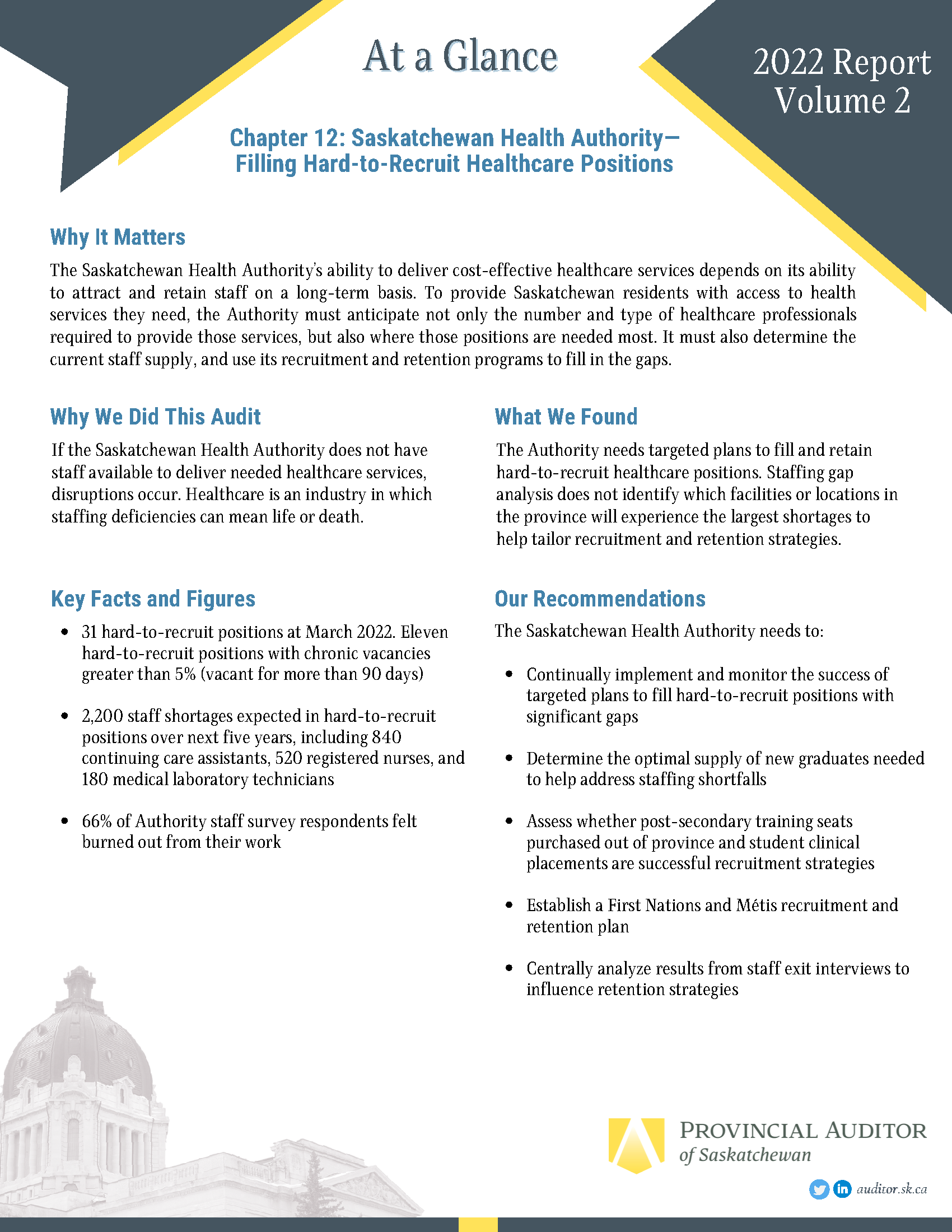
[2022-12-07] More than 2,000 health-care workers needed over the next 5 years, auditor says
In a report tabled on Tuesday, Provincial Auditor Tara Clemett noted that, over the next five years, the Saskatchewan Health Authority (SHA) is projecting a shortage of 2,200 “hard-to-recruit” health care workers. Specifically, the SHA expects to be short 850 continuing care assistants, 520 registered nurses, and 180 medical laboratory technicians. Other challenging positions to be filled include psychologists, respiratory therapists, audiologists, perfusionists, physical therapists, speech language pathologists, emergency medical technicians in rural and remote areas, and cooks. Clemett said that the province has to go beyond “the status quo,” noting that the SHA needs to address the gaps in the workforce. Clemett made a number of recommendations in her report, including optimizing the supply of new graduates to help address staffing shortages, conducting exit interviews to determine strategies for retaining employees, and creating a First Nations and Métis recruitment and retention plan.
cbc | thestar | regina.ctvnews | leaderpost | globalnews | auditor.sk
[2022-12-06] New family doctor residency positions target Nova Scotians who study abroad
As part of Nova Scotia’s Action for Health, the provincial government will make it easier for Nova Scotians who attend medical school outside Canada to complete their residency at home. Previously, the province had designated 6 seats for international medical graduates interested in completing their residency in Nova Scotia. The government has now created an additional 10 seats for medical graduates who completed their studies outside Canada. Priority will be given to those with a “connection” to Nova Scotia, which includes being a resident of Nova Scotia and having attended high school or university in the province for at least two years. If any positions are not filled by Nova Scotians in the first round of placements, the spots will be open to international medical graduates without a provincial connection. After completing their placements, doctors must work in an area of high demand in the province for three years. Moreover, in partnership with Dalhousie University, the province has created 10 new residency seats in family medicine across the province for 2023, which will increase the number of family residency spots to 58.
novascotia | halifax.citynews | atlantic.ctvnews
[2022-12-06] Alberta government surrendering power to impose pay deals on doctors
As part of a four-year compensation agreement with the Alberta Medical Association (AMA) ratified in September, Alberta’s Health Minister Jason Copping tabled Bill 4, The Alberta Health Care Insurance Amendment Act, 2022 on Monday. If passed, the legislation will repeal the section of the health care insurance law that allows the province to unilaterally “terminate and replace” compensation agreements with doctors, a step former health minister Tyler Shandro took in February 2020. In return, once the legislation takes effect, the AMA has agreed to withdraw its $255 million lawsuit against the province for allegedly breaching their Charter rights. Dr. Fredrykka Rinaldi, president of the AMA, said that the introduction of Bill 4 was an important step in “rebuilding the relationship between the government and doctors.” Under the most recent agreement, physician compensation will increase by an average of 4% over the next four years, including a lump sum 1% increase as a “recognition payment” for work over the course of the COVID-19 pandemic.
cbc | edmontonjournal | edmonton.ctvnews
[2022-12-05] New retention and signing bonuses for Yukon nurses
The Yukon territory and the Yukon Employees’ Union (YEU) have negotiated a two-year deal for government nurses. The Yukon’s Minister of Health and Social Services announced that the new $6 million package is in recognition of the work nurses do in the territory, and that it incentivizes new hires while addressing turnover and high vacancy rates. The package includes an immediate bonus of $15,000 for Registered Nurses (RNs) and Nurse Practitioners (NPs), and $8,000 for Licensed Practical Nurses (LPNs), with a second set of retention bonuses in the same amount to be issued on April 1, 2023. Signing bonuses will be offered to new RNs and NPs ($7,500) and LPNs ($4,500), and new nursing graduates will be reimbursed for their exam fees. Finally, the package includes a $10,000 bonus for Primary Care Nurses and Primary Care Nurses in Charge working in Yukon communities. The YEU and territory will continue collective bargaining on December 14.
yukon | yukon-news | whitehorsestar
[2022-12-05] Virtual care in Ontario and B.C.
The province and the Ontario Medical Association (OMA) have agreed on a new fee structure for virtual care that came into effect on December 1. During the pandemic, the province allowed doctors to charge $80 for virtual sessions in an effort to curb the spread of COVID-19. Doctors are currently allowed to bill the province at that rate only if they have had in-person consultation with a patient within the preceding two years. OMA explains that it “believes in the importance of providing virtual care in the setting of an ongoing physician-patient relationship.” Under the new agreement, the revised rate for patients who are not deemed to have an ongoing and pre-existing relationship with the doctor is $20 for a video visit and $15 for a telephone visit. One virtual care platform notes that the “repercussions of the billing changes will likely strain the physical health system further,” emphasizing the current “crisis in access to care.”
globalnews
In parallel with developments in Ontario, the province of British Columbia and doctors are now discussing possible changes to long-term virtual care. “There is clearly some benefit to (virtual health care) and that is why we are working to make the best clinical decisions,” said B.C. Health Minister Adrian Dix. According to the B.C. government, it could be months until a decision is made about cost.
globalnews
[2022-12-05] Red Cross staff to help CHEO get through respiratory virus season
Ottawa’s children’s hospital (CHEO) has been operating over capacity due to a surge in COVID, RSV, and flu related illnesses over the past few weeks. CHEO responded by redeploying staff from surgical and medical care units, opening a second pediatric ICU, sending some teenage patients to nearby adult hospitals, and asking for extra support from organizations across the region. The Red Cross has answered the call by committing a team of non-clinical staff, scheduled to arrive at CHEO as early as this week, to support the hospital’s clinical teams wherever possible.
cbc | toronto.citynews | ottawacitizen
[2022-12-02] Québec health minister asks nurses to come back to help struggling health care system
At a national assembly press scrum on Thursday, Québec’s Health Minister Christian Dubé called on nurses to help with the province’s Info-Santé 811 phone line, which received approximately 10,000 calls on Wednesday. While the 811 line is “working very well,” the service is experiencing a staff shortage. The province is now looking for nursing students, retired nurses, or nurses currently employed in the private sector to help answer calls. Minister Dubé noted that the telehealth system needs “up to 5,000 nurses to answer the phones” in the next few weeks. The president of the Fédération interprofessionnelle de la santé du Québec (FIQ), which represents 76,000 health care workers including nurses and nursing assistants, responded that Dubé’s plea shows that he is “out of touch… with reality” given the shortages elsewhere in the public health network.
montreal.ctvnews | cbc | ici-radio.canada
[2022-12-02] Unions discuss court ruling Bill 124 unconstitutional
According to experts and advocates, Wednesday’s decision by the Ontario Superior Court of Justice to strike down Bill 124 is a “pivotal moment that exposes long-standing problems.” Bill 124 limited wage increases to 1% for three years, targeting female-dominated professions such as nurses and teachers; police officers and firefighters were not affected by this legislation—a discrepancy that has raised criticisms about the gender disparity embedded in the law. Dr. Ivy Bourgeault, professor at the University of Ottawa, explains that “[t]here is an overarching devaluing of care work that is disproportionately undertaken by women.” Doris Grinspun, CEO of the Registered Nurses’ Association of Ontario, echoes this concern and draws attention to the urgent need to address the staffing crisis in nursing, especially with respect to the issue of compensation. Dianne Martin, CEO of the Registered Practical Nurses Association of Ontario, points out that “nurses go to school for as long or longer than police officers and face more violence on the job,” suggesting that the inclusion of female-dominated professions under Bill 124 is a sign that they are undervalued. The Globe and Mail reached out to the Ontario Minister of Health with questions about the gender disparity represented in Bill 124 but received no response.
theglobeandmail
[2022-12-01] Statistics Canada reports on changes in the healthcare workforce between 2016 and 2021
Statistics Canada reports that, although the number of workers in non-management health occupations grew by 204,000 (16.8%) between 2016 and 2021, the number of vacancies in these health occupations was “at record highs” in the summer of 2022 and have been increasing steadily since 2015. Statistics Canada attributes the challenges in filling these vacancies in part to the “extensive and specialized education required for many health occupations,” noting that in 2021 almost half of non-management health care workers required “a bachelor’s degree or higher” and an additional 22.8% required “two or more years of college or some extended training.” Furthermore, Statistics Canada draws attention to the diverse groups that make up the health workforce, highlighting the contributions of racialized communities to health care and pointing out that women continue to make up approximately 80% of these occupations.
statcan | cbc
[2022-12-01] More than 10% of Newfoundland & Labrador respiratory therapists resigned this fall
Six of the 56 full-time respiratory therapists employed by Newfoundland’s Eastern Health have quit their jobs since September, and two additional positions could become vacant in the coming months. Staff have indicated that the challenges they face include the general workload, issues related to overtime, and compensation. Gordon Piercey, president of the Association of Allied Health Professionals (AAHP), explains that respiratory therapists have been “stretched thin” during the pandemic, with “two therapists caring for up to 18 patients at a time.” He adds that the current staffing situation is “chaotic” and that staff are being asked to work consecutive shifts with just a few hours’ break in between. With respect to compensation, the AAHP claims that Newfoundland and Labrador respiratory therapists are the lowest paid in country. The union is seeking an immediate labour market adjustment in its collective bargaining with the province. It also questions Eastern Health’s recruitment strategy, pointing out that Nova Scotia has already approached the 2023 respiratory therapist class at Newfoundland’s College of the North Atlantic, offering $10,000 signing bonuses, relocation assistance, and 20% higher pay. Eastern Health responded that it is planning to approach the 2023 graduating class in December, offering a $10,000 bursary and full-time employment to successful applicants in exchange for a two-year service contract.
cbc | saltwire
 HHRnews.ca